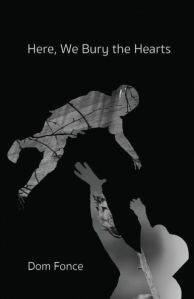
Purchase at Finishing Line Press
Here, We Bury the Hearts presents us with an apparent paradox: how can a book with so many ghosts and graves, with so much that is buried and by-gone, be so full of life and make us see the world as a space of vital purpose? The answer lies in the energy and breadth of Dom Fonce’s language, imagination, and heart, which persistently return us to the living present avid for the gifts it can give. These poems declare, with enormous subtlety and skill, that the heart is on the side of life and will not be buried.
– Steven Reese, author of Excentrica: Notes on the Text (BlazeVox, 2017)
Dom Fonce’s collection Here, We Bury the Hearts examines loss in Ohio—the state coined “The Heart of It All.” This collection mourns the death of a father in Youngstown against the backdrop of historic Ohio burials—Eugene in the Sabina Cemetery, Margaret Schilling at The Ridges in Athens, and The Great Serpent Mound in Adams County. The meditation on loss in Youngstown extends beyond the human into the postindustrial— “Portrait of Youngstown as the Archetypal Fallen Kingdom” opens with “In this scene, a cemetery, big as three towns, must sit /in the middle of the canvas.” Yet the speaker is undaunted, ready to “howl at the moon and dig up graves with my back paws” “for the love of the city.” Fonce’s powerful poems are heir to the larger tradition of burial poems that “dig out a path with a shovel/passed down from generation to generation.”
– Allison Pitinii Davis, author of Line Study of a Motel Clerk (Baobab Press, 2017)
In Here, We Bury the Hearts Dom Fonce goes gravedigging and surfaces with lines full of salvage. This book knows the importance of perspective—the act of looking for Fonce is not just a way “to knock back the choke of rust and regret,” but also a means of creation, of puzzling together a new dynamic between a town and its inhabitants, between a man and his family, between the present and ghosts of the past. These poems show us how “a city like a bonfire” can be both “castle and casket” if one is willing to dig deep enough.
– Rochelle Hurt, author of The Rusted City (Marie Alexander Poetry Series, 2014)
Review by Pamela R. Anderson
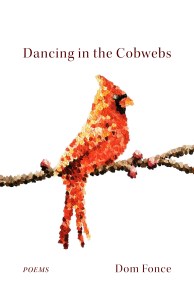
Purchase at Finishing Line Press
In poems that converge with nature and pay homage to family history, Dom Fonce’s chapbook Dancing in the Cobwebs explores mortality by capturing subtle moments of grace. For example, “Sonnet for Innocence” tells us that “a deer is born every second while / another dies curled up in rotting leaves,” and in “Grassman” a speaker states that “The things seen with child / eyes in backyards on backroads / are, at the very best, unreliable- / I understand this.” The rust belt landscape of Fonce’s collection delivers a welcome kind of heartbreak, an edge of tenderness along with a prayer for all that is lost.
– Mary Biddinger, author of Department of Elegy (Black Lawrence Press, 2022)
In Dom Fonce‘s new chapbook, the natural world hums and looms-not as pastoral setting but as a force that is sometimes “Drunk and dangerous,” sometimes “sweet with marigold.” Fonce’s shadow terrain is inflected with crucified frogs, moth-dust, Puffer fish, and blackflies, as well as attic ghosts, Newports ashing themselves, and skin that can’t be washed off-ominous talismans that “reshape matter and mass.” This is a book that doesn’t flinch from the composing and decomposing of the sublunary and psychic landscapes it explores. Remarkably revealing about the pain of living in the midst of death, Dancing in the Cobwebs speaks with vatic overtones from a place where “what you’ve asked for can’t be told.
– Philip Brady, Head Director of Etruscan Press
Half song, half sonnet, or half ghost story and half coming of age, what this book does is spirit and haunt. Again and again we are presented with what we have lost, large and small, and how those losses hold us accountable. Dancing in the Cobwebs forces a reader to consider how the world communicates with us, how it reaches out to get our attention, how it catches in our throats and refuses to let go.
– Catherine Wing, author of Gin & Bleach (Sarabande Books)
 domfoncepoetry.com